
World Cup 3-Cushion Yanggu 2026: PPPQ Round Complete, 12-Run Sets the Pace
The PPPQ round is done, all 48 matches played
The World Cup 3-Cushion in Yanggu opened on 2 November and its first stage is already decided: the PPPQ round produced a 12-run, two 2.000 averages and a match that ran to 79 innings. Here is what happened, and what comes next.
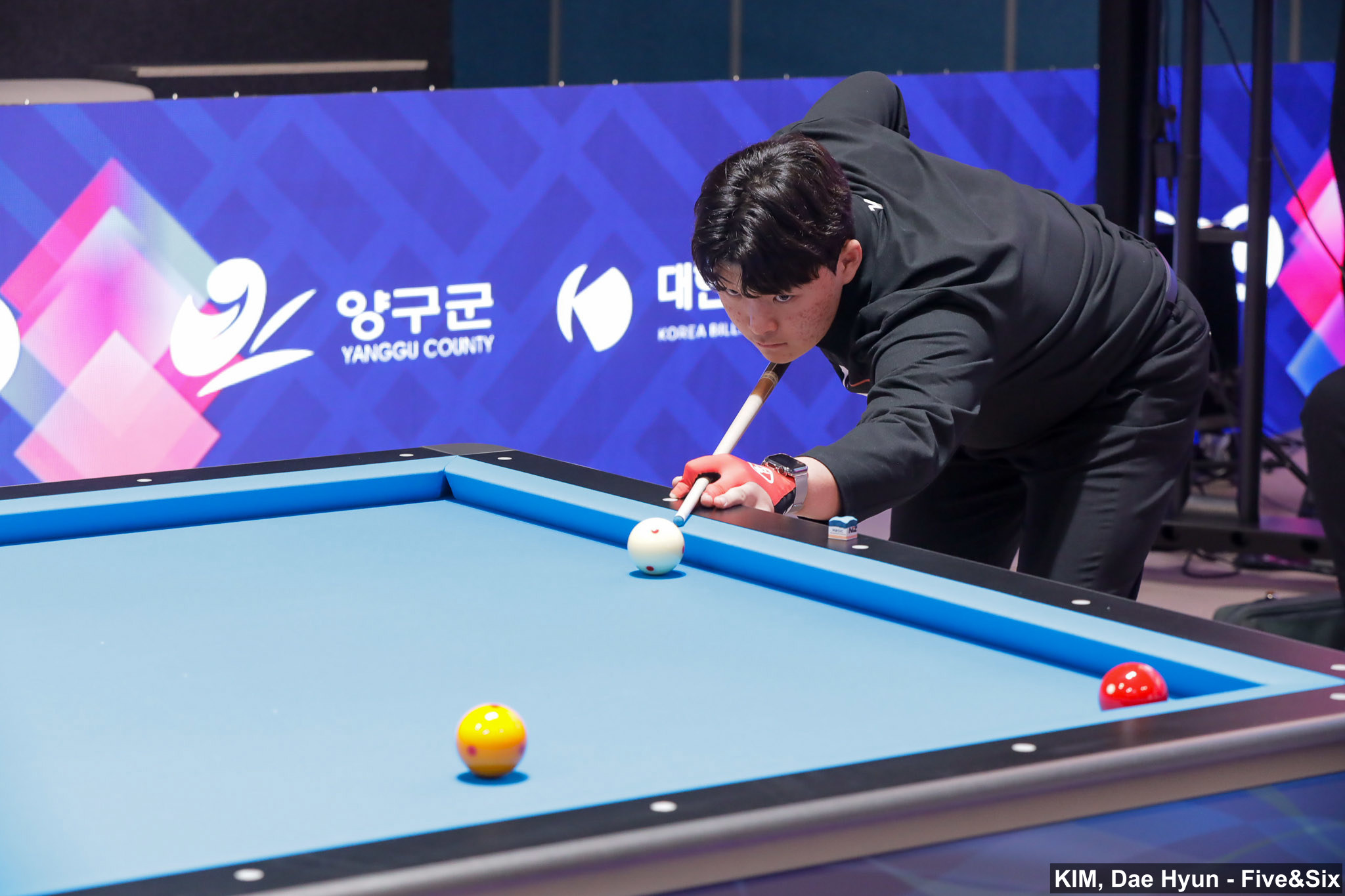
The World Cup 3-Cushion in Yanggu, Korea opened on 2 November and the first of its six stages is already complete. Every one of the 48 PPPQ matches carries a published result, with 2,353 points scored in the round.
The event runs seven days, from 2 to 8 November, and brings 149 players to the tables. It is the sixth World Cup of the 2026 cycle and the last one before Hurghada in December.
Full draw, stage-by-stage results and standings are on the World Cup 3-Cushion Yanggu 2026 tournament page.
A 12-run from Kim Dae Hyun
The biggest single run of the round came from Kim Dae Hyun, who put together 12 from the cue against Le Nguyen Nhu. The Korean won that match 30-28 in 18 innings, and no other player in the round reached 12.
Runs of that size separate a good day from a memorable one in three-cushion. A single 12 changes the innings a player needs for the whole match, and it usually arrives when the table is opening up.
The next best was a 10 from Jeong Yeok Geun. Behind those two the round stayed tight: most winners finished on runs of four to eight, and the gap between a controlled match and a struggle was often one visit to the table.
Two players averaged 2.000
Average is the cleanest measure of how someone played. Two players reached 2.000 across a full match: Kim Dong Ryong and Song Yun Do, both reaching 30 points in 15 innings.
That is a punishing rate. At 2.000 a player needs 15 innings to win a 30-point match, which leaves an opponent almost no room to recover once they fall behind.
Luis Aveiga of Ecuador came next at 1.765, taking 17 innings for his 30 points. The three together set the pace for the round.
Four matches decided on the final point
The closest finish was a genuine draw in points: Daniel Moreno and Kim Jin Youl finished 30-30, each taking 33 innings to get there.
Three more went to the last point. Satoru Yoneyama beat Lee Gyu Seung 30-29 in 32 innings, and Kim Hyeon Woo edged Kim Jae Hoon 30-29 in 25.
In the longest match of the round, Jhon Cohen beat Hiroshi Sasaki 30-29, after 79 innings each.
The widest margin belonged to Heo Chae Won, who won 30-4 in 26 innings. Moreno's 30-5 over Do Pham Thi Ngoc came next, closed out in 25.
Yanggu is the sixth World Cup of the 2026 cycle
Five World Cups have already been decided this year. Myung Woo Cho won Bogota, Frederic Caudron won Ho Chi Minh City, Cho won again in Ankara, Eddy Merckx took Porto, and Cho won the fifth in Lier.
That makes Cho the man to beat in Korea, and Yanggu is a place where he has already delivered: he won the Korean World Cup in 2025, after Merckx in 2023 and Dick Jaspers in 2024.
The UMB lists 14 seeded players for Yanggu, among them Cho, Merckx, Jaspers, Marco Zanetti, Tayfun Tasdemir, Martin Horn, Bao Phuong Vinh and Jeremy Bury, alongside Berkay Karakurt, Sidhom, Hofman, Thai, Tran and Heo.
Where the field stands, and what Yanggu pays
Before a ball was struck, the UMB Events Ranking had Cho on 524 points, Merckx on 412, Zanetti on 304, Horn on 282 and Jaspers on 280. Bao Phuong Vinh sat tenth on 247 and Bury fifteenth on 190.
That list is rebuilt automatically from published results across the World Championship and the last ten World Cups, event by event, with absence penalties kept in the column they belong to. The full breakdown and every earlier edition are on the 3-Cushion Individual World Events Ranking.
Yanggu pays the standard World Cup scale: 80 points to the winner, then 54, 36, 26, 18, 10 and 8 down the line. A deep run in Korea moves someone several places, and even a first-round exit keeps a player's counting events alive.
How the format works, from PPPQ to the last eight
Six stages stand between the full field and the trophy, and each one cuts the number of players still playing.
The PPPQ round is the widest entry point: 48 players in 16 groups of three, three matches each. The PPQ, PQ and Q stages then narrow the field, reshuffling who meets whom at every step.
The main tournament opens with 32 players in eight groups of four, 48 matches in all. The last 16 then play a straight knockout: round of 16, quarterfinals, semifinals and final, 15 matches to decide the title. Because every stage is created in advance, the full schedule is visible before a single ball is struck.
The event announcement lists Hollywood tables, Simonis 330 Prestige cloth and Aramith Prestige balls. Korea has the largest billiards economy in the world, and the qualifiers there are famously hard to survive.
Who to watch in the PPQ round
Form from the PPPQ round does not carry points forward, but it carries information. The two 2.000 averages and Kim Dae Hyun's 12 show who arrived at Yanggu already cueing well.
The PPQ round is where that matters most. A player who keeps a 1.500 average across two stages is genuinely hard to stop, because the innings he denies an opponent add up across a long week.
Individual records are on each player page, for example Kim Dong Ryong and Luis Aveiga, and every match is archived on the event page as soon as a result is entered.
Frequently asked questions
When is the World Cup 3-Cushion Yanggu 2026?
It runs seven days, from 2 to 8 November 2026, in Yanggu, Korea, across six stages from PPPQ to the final eight. It is the sixth World Cup of the year, before Hurghada in December.
How many players are in the field?
149 players are registered, with 48 matches in the opening PPPQ round and 14 players seeded by the UMB.
Who leads the world ranking before Yanggu?
Myung Woo Cho leads on 524 points, ahead of Eddy Merckx on 412 and Marco Zanetti on 304. The full ranking lists 497 players from 36 federations.
Where can I see the results?
On the Yanggu 2026 tournament page, which lists every match by stage with points, innings and high runs, and updates during play.
Follow the rest of the week
Yanggu 2026 continues through 8 November, with the PPQ, PQ and Q stages followed by the main tournament. The tournament page collects the schedule, the standings of each stage and the players still in, so you do not have to piece results together from several sources.
If you follow one player, open their page once. Their record of tournaments and matches stays online after the event closes, and the ranking page shows what the week did to their points.